FX swaps, forwards and currency swaps create forward dollar payment obligations that do not appear on balance sheets and are missing in standard debt statistics. Non-banks outside the United States owe
as much as $25 trillion in such missing debt, up from $17 trillion in 2016. Non-US banks owe upwards of $35 trillion. Much of this debt is very short-term and the resulting rollover needs make for dollar funding squeezes. Policy responses to such squeezes include central bank swap lines that are set in a fog, with little information about the geographic distribution of the missing debt. 1
FX 스와프, 포워드, 통화 스와프는 대차대조표에 나타나지 않고 표준부채 통계에서 누락된 달러 결제 의무를 창출한다. 미국 외 지역의 비은행들은 2016년 17조 달러에서 최대 25조 달러에 이르는 빚을 지고 있으며, 미국 외 지역의 은행들은 35조 달러의 빚을 지고 있다. 이 부채의 대부분은 매우 단기적이며, 이로 인한 롤오버는 달러 조달 압박(달러 롱 스퀴즈)을 야기할 가능성이 있다. 이러한 자금 조달 압박에 대한 정책적 대응으로써, 보이지 않는 안개 속에 형성된 중앙은행 스와프 라인들이 포함되어 있으며, 이렇게 눈에 보이지 않는 광범위한 부채에 대한 정보는 거의 없다.
*FX = 외환
*롤오버 = 선물 계약을 차월물로 이월하는 것
Embedded in the foreign exchange (FX) market is huge, unseen dollar borrowing. In an FX swap, for instance, a Dutch pension fund or Japanese insurer borrows dollars and lends euro or yen in the "spot leg", and later repays the dollars and receives euro or yen in the "forward leg".
외환 (FX) 시장에는 막대한 달러 차입이 있다. 예를 들어, FX 스와프 세계에서 네덜란드 연금펀드나 일본 보험사는 "Spot leg"로써, 달러를 차입하고 유로를 대출해주며, 나중에 "Forward leg"로써 달러를 상환하고 유로나 엔을 받는다.
*FX 스와프의 두 다리(Spot leg 및 Forward leg): 현물(spot) 환율로 달러를 빌려서 미래 특정 시점(선물 = forward)에 달러를 상환.
Thus, an FX swap, along with its close cousin, a currency swap, resembles a repurchase agreement, or repo, with a currency rather than a security as "collateral".2 Unlike repo, the payment obligations from these instruments are recorded off-balance sheet, in a blind spot.
따라서, FX 스와프는 그의 친한 사촌인 통화 스와프와 함께 "담보"보다는 통화 버전의 환매조건부채권(Repo)을 닮았다. 그리고 이러한 금융상품의 지급 의무는 대차대조표 밖의 사각지대에 기록된다.
The $80 trillion-plus in outstanding obligations to pay US dollars in FX swaps/forwards and currency swaps, mostly very short-term, exceeds the stocks of dollar Treasury bills, repo and commercial paper combined. The churn of deals approached $5 trillion per day in April 2022, two thirds of daily global FX turnover.
FX 스와프/포워드는 대부분 매우 단기적이며, 지불해야 하는 달러는 80조 달러 이상이고, 이 수치는 재무부 어음, 환매조건부채권(Repo) 및 상업 어음을 합친 것을 초과한다. 그리고 이러한 스와프 거래는 2022년 4월 하루 5조 달러에 육박했으며, 이는 일일 글로벌 외환시장 거래액의 3분의 2에 해당한다.
FX swap markets are vulnerable to funding squeezes. This was evident during the Great Financial Crisis (GFC) and again in March 2020 when the Covid-19 pandemic wrought havoc. For all the differences between 2008 and 2020, swaps emerged in both episodes as flash points, with dollar borrowers forced to pay high rates if they could borrow at all. To restore market functioning, central bank swap lines funnelled dollars to non-US banks offshore, which on-lent to those scrambling for dollars.
FX 스와프 시장은 자금 압박에 취약하다. 이는 대금융위기 때와 2020년 3월 코로나19 팬데믹이 대혼란을 일으켰을 때 분명하게 드러났다. 2008년과 2020년이 달랐음에도 불구하고, 스와프는 두 사건 모두에서 인화점으로 드러났고, (위기 상황에) 달러를 차입한 이들은 높은 금리를 지불해야 하는 처지에 놓였으면서도 간절히 달러를 찾아 헤맬 수 밖에 없었다. 시장 기능을 회복시키기 위해 중앙은행 스와프 라인은 달러를 찾아 허둥대던 해외의 비-미국 은행에 달러를 빌려주었다.
This off-balance sheet dollar debt poses particular policy challenges because standard debt statistics miss it. The lack of direct information makes it harder for policymakers to anticipate the scale and geography of dollar rollover needs. Thus, in times of crisis, policies to restore the smooth flow of short-term dollars in the financial system (eg central bank swap lines) are set in a fog.
이러한 대차대조표 밖에 존재하는 달러 부채는 표준 부채 통계에 포함되지 않고 있기 때문에 특별한 정책적 당면 과제가 발생한다. 직접적인 정보의 부족은 정책 입안자들이 달러 롤오버의 규모와 분산 정도에 대해 예측하기 어렵게 만든다. 따라서 위기 상황에서 금융시스템(중앙은행 스와프 라인 등)의 단기 달러 흐름을 원활하게 회복하기 위한 정책은 뚜렷하지 않다.
The missing dollar debt from FX swaps/forwards and currency swaps is huge, adding to the vulnerabilities created by on-balance sheet dollar debts of non-US borrowers. It has reached $26 trillion for non-banks outside the United States, double their on-balance sheet debt. Moreover, it has grown smartly since 2016, despite the often significant premium demanded on dollar swap funding (Borio et al (2016)). For banks headquartered outside the United States, dollar debt from these instruments is estimated at $39 trillion, more than double their on-balance sheet dollar debt and more than 10 times their capital.
FX 스와프/포워드 및 통화 스와프에서 보이지 않는 달러 부채는 거대하며, 비-미국 대출자들의 대차대조표상의 달러 부채로 인해 발생되는 취약성을 가중시킨다. 비-미국의 비은행들의 경우 26조 달러의 달러 부채가 있는데, 이는 그들의 대차대조표 부채의 두 배에 달한다. 게다가, 달러 스와프 자금에 종종 상당한 프리미엄이 요구됨에도 불구하고 2016년 이후 급격하게 증가했다. 비-미국 은행들이 이러한 방식으로 차입한 달러 부채는 39조 달러로 추정되는데, 이는 대차대조표상의 달러 부채의 두 배 이상이며, 자본의 10배 이상이다.
Payment obligations arising from FX swaps/forwards and currency swaps are staggering. Considering all currencies, outstanding amounts at end-June 2022 reached $97 trillion, up from $67 trillion in 2016 (Graph 1.A). This matched global GDP in 2021 ($96 trillion) and was three times global trade ($29 trillion). And it exceeded both global external portfolio investment ($81 trillion) and international bank claims ($40 trillion) at end-2021.
FX 스와프/포워드 및 통화 스와프에서 발생하는 결제 의무는 충격적이다. 2016년에 모든 통화의 미결제 잔액은 67조 달러였는데 2022년 6월 말에 이 금액은 97조 달러를 기록했다. 이 수치는 2021년 전 세계의 GDP와 동일하며, 전 세계 무역량의 3배에 달하는 수치이다. 또한, 전 세계의 외부 투자 포트폴리오(81조 달러)나 국제은행 채권(40조 달러)을 초과한다.
Dollar dominance is striking in this FX market segment, greater than in any other aspect of dollar use. As a vehicle currency, the US dollar is on one side of 88% of outstanding positions – or $85 trillion (Graph 1.A). An investor or bank wanting to do an FX swap from, say, Swiss francs into Polish zloty would swap francs for dollars and then dollars for zloty.
외환 시장에서의 달러의 지배력은 다른 어느 영역보다 거대하다. 기축 통화로써, 미국 달러는 미지급 포지션의 88% 또는 85조 달러를 차지하고 있다. 예를 들어. 스위스 프랑에서 폴란드 즐로티로 외환 교환을 원하는 투자자나 은행은 프랑을 달러로 교환한 다음 달러를 즐로티로 교환한다.
(한국 원화를 브라질 헤알로 교환하려면 원화 -> 달러 -> 헤알)
The very short maturity of the typical FX swap/forward creates potential for liquidity squeezes. Almost four fifths of outstanding amounts at end-June 2022 in Graph 1.B matured in less than one year. Data from the April 2022 Triennial Survey show not only that instruments maturing within a week accounted for some 70% of FX swaps turnover, but also that those maturing overnight accounted for more than 30%. When dollar lenders step back from the FX swap market, the squeeze follows immediately (Correa et al (2020))
FX 스와프/포워드의 매우 짧은 만기는 유동성 문제를 야기할 소지가 높다. 그래프 1.B에서 보이듯 2022년 6월 말에 존재하는 미지급 결제액의 4/5가 1년 안에 만기가 된다. 2022년 4월 트리엔날레 설문조사의 데이터에 따르면, 일주일 이내에 만기가 도래하는 거래는 FX 스와프 회전율의 약 70%를 차지하며, 하룻밤 안에 만기가 도래하는 거래는 30% 이상을 차지한다. 달러가 FX 스와프 시장에서 빠져나가면, 거의 즉각적인 유동성 문제가 발생할 것이다.
Financial customers dominate non-financial firms in the use of FX swaps/forwards. Non-bank financial institutions (NBFIs), proxied by "other financial institutions3 in Graph 1.C, are the biggest users of FX swaps, deploying them to fund and hedge portfolios as well as take positions. Despite their long-term foreign currency assets, the likes of Dutch pension funds or Japanese life insurers roll over swaps every month or quarter, running a maturity mismatch. For their part, dealers' non-financial customers such as exporters and importers use FX forwards to hedge trade-related payments and receipts, half of which are dollar-invoiced (Boz et al (2020)). And corporations of all types use longer-term currency swaps to hedge their own foreign currency bond liabilities (McBrady et al (2010), Munro and Wooldridge (2010)).
FX 스와프/포워드를 사용하는 기관은 금융 기관이 압도적으로 많다. 그래프 1에서 "다른 금융 기관"으로 표시되는 비은행 금융 기관(NBFI)은 FX 스와프를 가장 많이 사용하는 유형이며, 이들은 스와프를 이용해 펀드 및 헤지 포트폴리오를 구축한다. 네덜란드 연금 펀드나 일본 생명 보험사들은 장기 외화자산을 보유했음에도 불구하고 매달 또는 분기마다 스와프를 롤오버해야 하는 미스매치(mismatch)를 겪고 있다. 수출입업자와 같은 비금융 고객들은 무역 관련 결제와 송장을 헤지하기 위해 FX 포워드를 사용하는데, 이 중 절반은 달러 송장이다. 그리고 모든 유형의 기업은 외화 부채를 헤지하기 위해 장기 통화 스와프를 사용한다.
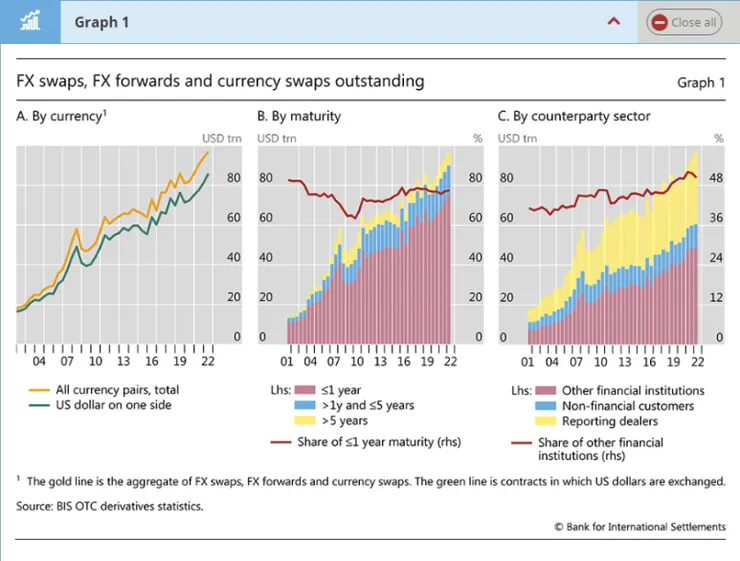
미결제 외환 스와프, 포워드, 통화 스와프 금액
Just how large is the missing dollar debt from FX swaps/forwards and currency swaps? At end-June 2022, dealer banks had $52 trillion in outstanding dollar positions with customers. Non-banks had dollar obligations of half of this amount, $26 trillion.4 This sum has been growing strongly, from $17 trillion in 2016
FX 스와프/포워드 및 통화 스와프로 인한 달러 부채의 규모는 얼마나 되는가? 2022년 6월 말, 증권사들은 고객들과 함께 약 52조 달러의 미결제 달러를 가지고 있다. 비은행은 이 중 절반에 해당하는 금액인 26조 달러의 달러 결제 의무를 지고 있으며 이 금액은 2016년 17조 달러에서 크게 증가해왔다.
This $26 trillion dollar debt is likely owed by entities outside the United States, for which the dollar is a foreign currency.5 They borrow dollars largely to hedge their dollar receivables and investments in a world in which the dollar is the dominant international currency. By contrast, NBFIs in the United States hedge their modest foreign currency assets by lending – not borrowing – dollars via FX swaps. And businesses in the United States have scant foreign currency payables to hedge by borrowing dollars off-balance sheet.
이 26조 달러의 부채는 달러가 외화인 비-미국 기업들이 가지고 있는 것으로 보이며, 그들은 주로 달러를 빌려 달러 채권과 달러가 지배적인 국제 통화인 세계에서의 투자를 헤지한다.
대조적으로, 미국의 비은행 금융기관은 FX 스와프를 통해 달러를 차입하는 게 아닌 달러를 빌려줌으로써 그들의 외화 자산을 헤지한다. 그리고 미국의 기업들은 대차대조표에서 달러를 차입함으로써 헤지할 외화 지불금이 거의 없다.
The off-balance sheet US dollar debt of non-banks outside the United States substantially exceeds their on-balance sheet debt and has been growing faster. At end-June 2022, the missing debt amounted to as much as double the on-balance sheet component (Graph 2.B), which was estimated at "only" $13 trillion (Graph 2.A). Moreover, the missing debt was "only" 1.6 times larger in 2016.
비-미국의 비-은행들의 미국 달러 부채는 실질적으로 그들의 대차대조표를 초과하고 있으며, 점점 더 빠르게 증가하고 있다. 2022년 6월 말, 눈에 보이지 않는 부채는 대차대조표 전체의 두 배에 달하는 것으로 추산되었는데, 여기서 부채는 13조 달러에 달하는 것으로 추정되며 눈에 보이지 않는 부채는 2016년에 1.6배에 달했다.
For their part, banks headquartered outside the United States, including some dealers in FX swaps, have even larger missing dollar obligations.7 These banks deserve focus because of their limited access to the Federal Reserve's discount window for dollars. Their estimated off-balance sheet dollar obligations of $39 trillion at end-June 2022 were much higher than the $15 trillion in on-balance sheet dollar debt (Graph 2.C) and almost half as big as their combined total liabilities.
FX 스와프와 관련된 일부 딜러를 포함하여 비-미국 은행들은 눈에 보이지 않는 달러 채무가 매우 크다. 이 은행들은 연방준비제도의 달러 할인 창구에 대한 접근이 제한되어 있기 때문에 유의할 필요가 있다. 2022년 6월 말에 그들이 추정한 39조 달러의 대차대조표 밖의 달러 부채는 대차대조표상의 달러 부채인 15조 달러보다 훨씬 많고 그들 부채의 거의 절반에 달한다.
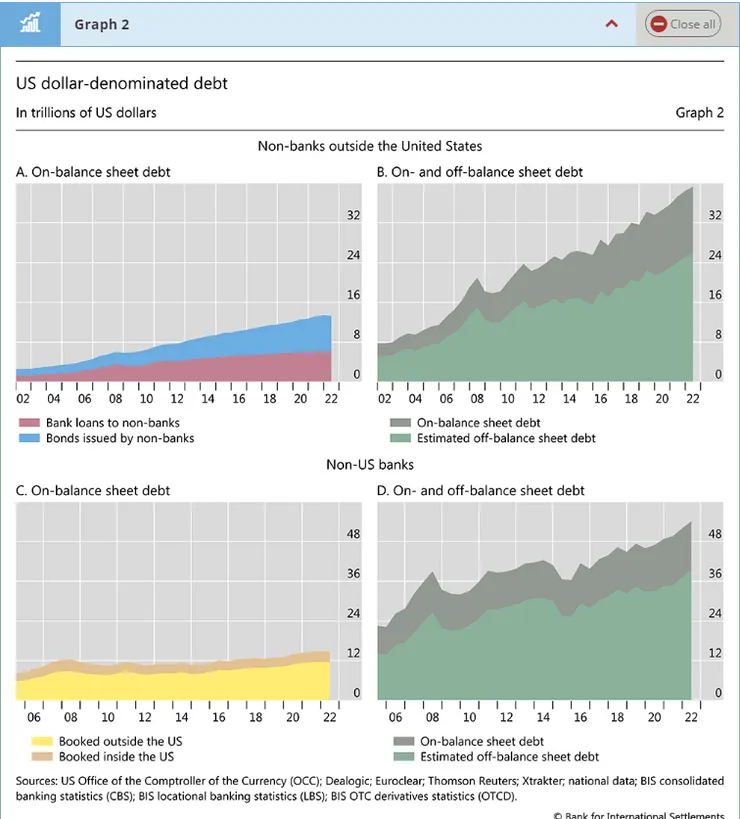
거대한 달러 부채
쉬운 요약
외환 시장에 존재하는 달러 부채는 엄청나게 거대하며, 무서운 것은 이 엄청난 부채는 통계상으로 측정이 안 되고 있다.
전 세계적으로 이렇게 엄청난 달러 부채가 있는 상황에서 금리 인상 등의 영향으로 달러 유동성이 부족해질 때 수많은 금융, 비금융 기관들이 외환 시장에서 상환해야 할 단기적이며 지속적인 달러 부채를 당장 갚지 못할 정도로 달러가 급속도로 부족해질 수 있으며, 이로 인해 달러 롱 스퀴즈가 발생할 수 있다.
근데 문맥상은 달러 가치 상승이니 숏스퀴즈를 잘못 쓴게 아닌가 싶네요
요