새소식
미국 애플 지원 포럼에 나의 찾기 서비스 제한에 대해 영어로 글을 올렸습니다.
조회 3,842 · 공감 21 · 댓글 12
https://discussions.apple.com/thread/255210088
Title: On the Restrictions of Apple's "Find My" Service in South Korea
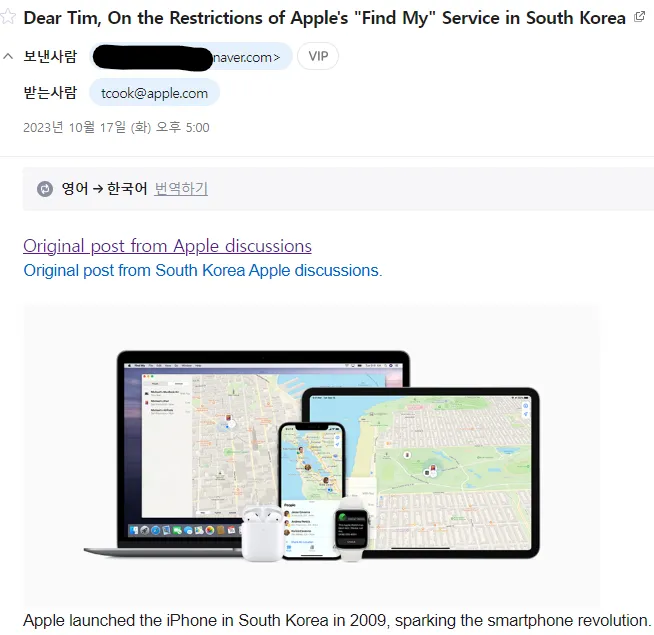
Apple launched the iPhone in South Korea in 2009, sparking the smartphone revolution. Since then, they have released products like the iPad, Apple Watch, AirPods, and AirTag, significantly changing people's lifestyles and quality of life.
One out of every four smartphones in South Korea is an iPhone, and over 10 million people use it. If we also count the unrecorded number of iPad users, the number is much higher.
Despite the widespread use of Apple devices in South Korea, the "Find My" feature, which helps locate a lost device, has never been activated throughout most of South Korea since its introduction in 2010. South Korea is the only country in the world where this feature is intentionally blocked.
Due to this limitation, when Apple devices are lost within South Korea, users cannot use the device's built-in location sharing feature. Even if the device is connected to the internet, they have to rely on memory or the sound the device makes. Moreover, if the device's internet connection is lost, they cannot determine the last known location. Many people, both Koreans and foreigners in South Korea, have lost Apple devices and were shocked to see "No Location Found" in Find My. Realizing it meant "lost forever" would undoubtedly turn their shock into despair.
Apple devices also have a "People" feature allowing users to share their real-time location with each other. This is useful for families and friends to know each other's whereabouts and in emergencies. There have been instances in the US where kidnapped individuals were quickly located by the police using the Apple Watch's Find My service. However, this feature is entirely unusable in South Korea, leaving iPhone-using families helpless in emergencies.
While iPhones have some form of location tracking based on mobile carrier towers, its accuracy pales in comparison to device-based GPS. According to data, the accuracy of carrier-based location tracking is between 100m to 200m at best, and much worse in less populated areas. In contrast, iPhone's GPS accuracy is less than 1m.
AirTags, designed to show their location on a map, have been reduced to merely helping find items within a room in South Korea. iPhones can also act as detectors for AirTags, recognizing their location and relaying it to the owner. While many third-party products overseas have launched using AirTag's functionality, they are practically useless in South Korea due to these restrictions.
Apple claims they cannot use the Find My location data due to local laws. However, there are inconsistencies in this claim. For instance, the Find My service works perfectly in territories like Baekryeongdo, Ulleungdo, and Dokdo, which are under South Korean jurisdiction. Apple's adherence to a supposed South Korean law that requires storing location data for six months is also questionable, given that other services like the Fitness app and photo geotagging seem to store and utilize location data without issues.
As of December 1, 2022, many tech reviewers and influencers have covered Apple devices, but none have highlighted this inconsistency in the Find My service. Even information that the service works in some parts of South Korea was missing. It seems that most South Koreans have either taken this limitation for granted or are indifferent to it.
Some might argue that people should simply not lose their belongings in the first place. However, humans are imperfect. No one intentionally loses things, and even if one is careful, others might mistakenly or intentionally take their belongings. Services like "Find My" exist to minimize the damage from such incidents.
Apple should promptly address and resolve the limitations of the Find My service in South Korea.
더불어, 같은 글을 팀쿡(tcook@apple.com) 애플 CEO, 애플 본사 대외홍보지원팀(media.help@apple.com)에게도 보냈습니다.
아무쪼록 미국 본사에게도 한국에서의 나의 찾기 문제에 대해 알게 되었으면 좋겠습니다.
댓글 12
해외 나갈 때마다 제 숙소에 있는 맥북, 에어팟이 보이는걸 보면 신기하면서도 슬픕니다..
피드백 채널과 팀쿡 메일, 케이스ID 만들어서 지속적인 상담을 통한 피드백 등으로 의견 전달하는게 애플쪽으로 의견이 가지 않을까 싶습니다.
사용자가 직접 위치 가져다 쓰는건 문제 없습니다. 그래서 사진에 지오태킹을 남기거나 운동 기록에 트래킹 이력 남기거나 가능합니다.
제 3자인 위치 서비스 사업자가 서비스 이용자의 위치를 가져다 쓰려면 국내에선 위치서비스법을 지켜야할 뿐입니다.
구글과 마이크로소프트는 지켰기 때문에 국내에서 구글 지도 타임라인, 구글 내 기기 찾기, 마이크로소프트 내 디바이스 찾기 등의 서비스를 하고 있습니다.
https://namu.wiki/w/%EB%82%98%EC%9D%98%20%EC%B0%BE%EA%B8%B0
개인 위치데이터를 6개월간 보관해야하는게 더 이상한 것 같은데요
차이도 크지만, 제일 이상한건 내 위치정보를 6개월을 저장해야 한다는거죠..
이건 애플에게 요구해봤자 안될거에요.. 기업 입장은 개인정보를 길게 보관할수 없다는 입장이니..
정부가 이건 손을 봐야 한다 봅니다..